Introduction
Packaging roll films are the most widely used packaging materials for food, daily necessities, cosmetics, household products and industrial goods. As a flexible, cost-effective, and high-efficiency packaging solution, roll films are perfectly compatible with automatic packaging machines, bringing stable sealing performance, beautiful printing effects, and low packaging costs for manufacturers worldwide.
Many importers, factory purchasers and packaging engineers often encounter problems such as unstable sealing, film deviation, wrinkling, or material waste during the use of roll films. These issues are mostly caused by incorrect installation and operation, rather than product quality problems.
In this guide, we will share the standard complete usage process of packaging roll films, suitable for all types of food packaging, daily chemical and daily necessity packaging roll films, helping your production line run efficiently and reduce packaging failure rates.
What Are Packaging Roll Films?
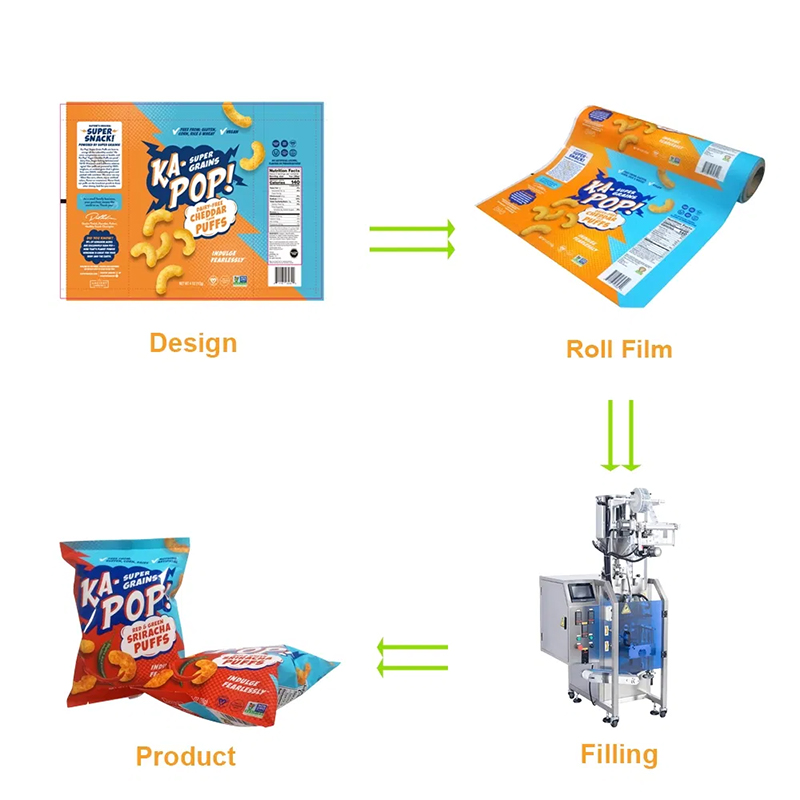
Packaging roll film is a continuous flexible packaging material rolled into a roll shape, made of PE, PET, AL, CPP and other composite materials. It is specially used for automatic vertical packaging machines, horizontal packaging machines, and flow wrap machines.
Our roll films cover full scenarios:
Food grade roll films: For snacks, nuts, candies, frozen food, seasoning, beverage powder, etc.
Daily necessity roll films: For wet wipes, facial masks, soap, detergent pods, toiletries, small household goods
Functional composite roll films: Moisture-proof, waterproof, oxygen-proof, high-temperature resistant, anti-extrusion packaging films
Pre-Use Inspection: Avoid 80% of Packaging Failures
Before installing the roll film on the machine, please complete the following simple inspections to ensure smooth production:
1. Appearance & Quality Check
Check whether the roll film has scratches, wrinkles, bubbles, printing offset, color difference, edge cracks or foreign impurities. Confirm that the film thickness, width and tube core size match your packaging machine parameters.
2. Environment Check
Roll films are sensitive to humidity and high temperature. Please ensure the production environment is dry, ventilated and dust-free. Too high humidity will cause the film to absorb moisture, resulting in poor heat sealing; high temperature will soften the film and affect molding.
3. Machine Parameter Confirmation
Confirm the machine’s unwinding speed, sealing temperature, traction tension and cutting position. Different composite materials (PE composite, PET composite, aluminum foil composite) correspond to different optimal parameters.
Step-by-Step Usage Guide for Packaging Roll Films
This is the standard universal operation process, applicable to most automatic packaging machines on the market.
Step 1: Fix the Roll Film on the Machine Unwinding Shaft
Take out the packaging roll film, check the inner tube core direction, and stably install the film roll on the machine’s unwinding roller. Ensure the film roll is fixed without left and right shaking, which can effectively prevent film deviation during operation. Adjust the brake tension properly to avoid too loose or too tight unwinding.
Step 2: Thread the Film According to the Machine Track
Pull out the head of the roll film, and thread it along the machine’s standard guide roller and traction roller track. It is necessary to ensure the film is flat and free of torsion, folding and offset. For printed roll films with patterns and text, confirm the positive and negative sides and the printing direction to avoid reversed packaging.
Step 3: Adjust Traction Tension
Tension adjustment is the key to stable packaging. If the tension is too tight, the film will be stretched and deformed, resulting in pattern distortion and easy tearing; if the tension is too loose, the film will be wrinkled and stacked. Fine-tune the tension equipment to keep the film flat and smooth during continuous operation.
Step 4: Set the Heat Sealing Temperature & Speed
Set parameters according to the roll film material characteristics:
Ordinary PE composite film: Sealing temperature 110℃-130℃, medium speed
PET composite film: Sealing temperature 130℃-150℃, stable speed
Aluminum foil composite film: Sealing temperature 150℃-180℃, low and stable speed
After parameter setting, conduct 3-5 trial sealings to check the sealing firmness, no cracking, no air leakage, and flat sealing edge.
Step 5: Trial Production & Fine Adjustment
Start the machine for low-speed trial production, check the finished packaging effect: observe whether the bag body is flat, whether the cutting position is accurate, whether the pattern is complete, and whether the sealing edge is neat. If there are deviations, slightly adjust the tension, temperature and cutting position until the product meets the standard.
Step 6: Formal Continuous Production
After the trial production is qualified, stabilize the machine speed and carry out mass production. Regularly check the unwinding condition and packaging quality during production to ensure consistent product effect.
Common Problems & Solutions in Roll Film Usage
1. Poor heat sealing / easy to crack
Cause: Insufficient temperature, uneven tension, or damp film surface
Solution: Properly increase the sealing temperature, adjust tension, and keep the production environment dry
2. Packaging film wrinkling
Cause: Unstable tension, uneven roller pressure, film deviation
Solution: Re-calibrate the film position, balance roller pressure, and stabilize unwinding tension
3. Pattern printing offset
Cause: Unstable machine speed, film stretching
Solution: Fix the machine operation speed and adjust the tension to a moderate level
4. Air bubbles on the sealing edge
Cause: Dust or sundries on the film surface, excessive temperature
Solution: Clean the machine and film surface, and appropriately reduce the sealing temperature
Daily Storage & Maintenance Tips for Roll Films
Store roll films in a dry, cool and dust-free warehouse, avoid direct sunlight and high temperature humidity
Place the film roll vertically, avoid horizontal extrusion to prevent film deformation
Use the film in the order of production date to avoid long-term stockpiling affecting sealing performance
Seal the unused film roll with packaging bags to isolate moisture and dust
Why Choose Our Custom Packaging Roll Films?
We are a professional manufacturer of custom packaging roll films, supporting one-stop customized services including material selection, size customization, color printing, functional treatment (moisture-proof, high-temperature resistant, antibacterial).
Our advantages:
Food safety grade materials, compliant with EU, FDA food packaging standards
Smooth film surface, stable tension, no wrinkling and no deviation during machine operation
Precision color printing, high reduction of custom patterns and logos
Wide application: food, daily necessities, cosmetics, industrial products packaging
Support small batch customization and large batch wholesale, fast delivery
Final Words
Correct use and maintenance of packaging roll films can greatly improve your packaging efficiency, reduce product defective rate and production cost. Standard operation is the premise of stable packaging effect.
If you have any questions about roll film matching, machine parameter setting, or customized packaging film needs, welcome to contact our professional team for free technical guidance and quotation!